Video Games
Rosalina
An In-Depth Character Analysis
Since her debut in 2007’s Super Mario Galaxy for the Nintendo Wii, Rosalina has cemented herself as a staple character in the Super Mario main cast. However, despite her many appearances, there is still much debate and speculation among fans about her character and backstory.
The recent release of The Super Mario Galaxy Movie has presented many fans with a renewed interest in Rosalina’s origins from the games, which leaves a lot to the player to interpret themselves. This essay aims to examine and interpret the full breadth of Rosalina’s video game appearances in the Super Mario franchise, both mundane and remarkable, up to and including her appearance in Super Mario Bros. Wonder – Nintendo Switch 2 Edition + Meetup in Bellabel Park.
The first step in analyzing Rosalina’s character is recounting her depictions in Super Mario Galaxy and Super Mario Galaxy 2, the follow up game. This means establishing a baseline for analysis by describing the events from the media as told to us, known as the text. Text refers to the work itself. Despite its name, it is anything directly provided by the work, not just text. For example, stills and cutscenes.
Next, the text will be analyzed directly and indirectly through relevant paratext from outside the media. Paratext is anything surrounding the work, but not from the work itself. This includes developer interviews, manuals, and concept art. Japanese official sources will generally be considered more reliable than English official sources when applicable.
Super Mario Galaxy and Super Mario Galaxy 2 will be the only two games recounted in their entirety, though text and paratext from other games and media may be referenced in the analysis section. Super Mario Galaxy is essential to this analysis because it is the game that Rosalina debuted in and the one that offers the most insight into her character and backstory. Super Mario Galaxy 2 expands upon Super Mario Galaxy. Both games were directed by Yoshiaki Koizumi. While the games released in 2007 and 2010 respectively, additional content from their 2025 re-releases will be referenced.
It is important to acknowledge the role of authorship in media analysis. This doesn’t just mean separating the movie continuity from the game continuity. The Super Mario franchise does not follow one sacred text. Like in comic books, characters are living story lines, which are passed from author to author, with each one giving their own interpretation of it. While Mario was created by Shigeru Miyamoto, he has not been the director of a Super Mario game on a Nintendo system since 1996’s Super Mario 64. Likewise, most of Rosalina’s appearances did not have Koizumi as a director, despite him having the most say in the backstory of the character. While other authors may do their best to accurately reflect the original author’s intent, it cannot be assumed that this is always true.
Furthermore, the Super Mario video game franchise prides itself on prioritizing fun gameplay mechanics over intricate story. This doesn’t mean story doesn’t exist in any of the games, but it does mean that canon and consistency will take a backseat in the service of gameplay.
Does this mean analyzing any story aspect of this series is futile? Yes. Am I still going to do it? Absolutely.
This will be a literal reading and retelling of the English version of Super Mario Galaxy and Super Mario Galaxy 2 chronologically from Rosalina’s perspective, with analysis and relevant paratext to follow separately.
Note: If you are already familiar with the source material, feel free to skip to the analysis section. Consider this a spoiler warning.
Super Mario Galaxy
“A very, very long time ago,” a young Rosalina lives on a blue planet with her brother and parents. Her mother wears blue earrings and her father has a mustache1. At some point during her childhood, her mother passes away, and Rosalina is left with the belief that her mother would watch over her from the sky.
One day, Rosalina discovers a rusted, mushroom-shaped spaceship alongside a Luma. The Luma explains that they had been waiting for its mother, who they expect to arrive on a comet. Rosalina promises to wait with the Luma, but years pass without a sighting. Rosalina offers to help fix the spaceship and go into space to more proactively search. She packs her father’s telescope, her brother’s butterfly net, a stuffed bunny, bread, milk, jam, and apricot-flavored tea; however, she neglects to bring water.
The pair fix the spaceship and fly into space. Rosalina quickly realizes that her rations may not be sufficient and that she forgot to bring water. The Luma shares some of their Star Bits with her. They collect more by catching them using the butterfly net.
Later, Rosalina sees a bright turquoise blue comet and urgently asks the Luma to land on it. The comet is made of ice and could be used as a source of water. The two decide to ride the comet to continue their search.
One night, Rosalina dreams of her late mother. Dressed in light blue, her mother says she will watch over her like “a star in the clouds.” She awakens with tears in her eyes and laments that she will never see her mother again. The Luma joins Rosalina and cries that they will never see their mother either.
The pair continue their search to no avail. The Luma becomes depressed. Rosalina comforts them and says that she will take care of the Luma, becoming their adoptive mother.
Planning their new path in life, the pair begin building a home on the comet. Conveniently, the comet contains tools and furniture buried in the ice. The two manage to build a house, much too large for just two residents. Rosalina wishes her father, brother, and mother were there. Instead of sleeping in the house, she elects to sleep in the spaceship.
Some time passes, and the comet passes by a planet, where an apricot-colored Luma appears. There is tension as the two Lumas simply stare at each other in silence. The original Luma claims Rosalina as their mother. The apricot Luma does the same. A swarm of Lumas appear, all claiming Rosalina as their mother. Rosalina erupts in laughter, adopts them all, and gives each a name.
After searching one-hundred comets, Rosalina thinks of her home planet. She uses her father’s telescope to view her home planet and brings into view a terrace on a hill in front of a castle. She recognizes this hill from her time on the planet. She recalls stargazing with her father in the middle of the night using his telescope, sledding with her younger1 brother on snowy days, and having picnics with her mother on sunny days.
Reminiscing about her mother causes Rosalina to break down in tears in front of the Lumas. She becomes homesick, wanting to return to her home planet and see her mother. She begins to shout in sorrow.
“But I know she’s not there! I knew all along that she wasn’t out there in the sky! Because… because… she’s sleeping under the tree on the hill!”
After some time passes, Rosalina becomes homesick again. The original Luma attempts to console her and tells her that her mother will always be a part of her. Rosalina remains despondent. The Luma then has an idea. They transform into a comet and rockets their home across space. Surprised, Rosalina learns that the Lumas’ destiny is to transform into various things, including stars, comets, and planets. Rosalina is grateful for the Luma’s transformation and embraces the Lumas. It is said that this was the last time Rosalina was overcome by homesickness and cried.
The comet becomes a beacon to Lumas across the galaxies becoming the Comet Observatory, distinguished by its “proud white tail glittering in the sky”. Welcoming parties are held for new Lumas. Years pass, and the Comet Observatory continues its voyage through the universe, searching for the birthplace of the Lumas. Rosalina reads bedtime stories and plays lullabies on her guitar to the Lumas every night. Rosalina has fully accepted her role as adoptive mother of the Lumas, but she also plans to visit her home planet once every one-hundred years, hoping to visit her father1.
As the Comet Observatory travels to a new world, the Lumas express both anticipation and fear, before falling asleep to one of Rosalina’s lullabies. Rosalina reflects on the anxiety and excitement of meeting new people and old friends alike, and welcomes the prospect of visiting an entirely new world.
“Goodbye to those we met on this journey. I will cherish the memories forever. And to those we will meet on the next journey, hello.”
As planned, the Comet Observatory makes its once-in-a-century voyage through the galaxy of her home planet. However, the ship loses power when a force controlled by Bowser whisks away their Power Stars. Rosalina witnesses Bowser’s assault on the Mushroom Kingdom during their Star Festival celebration, held once every one-hundred years. Princess Peach (with a baby Luma) and her castle are lifted into space, along with Mario. Mario is blasted away and the baby Luma follows him. Mario wakes up on a small planetoid in the Gateway Galaxy.
Rosalina awaits Mario on the planetoid, entrusts him with the power of the baby Luma, and tasks him with rescuing the Grand Stars stolen from the Comet Observatory. She levitates and fades away. Mario and the baby Luma fly to several neighboring planets, eventually recovering a Grand Star. They fly to the Comet Observatory, which regains a fraction of its power from the star.
Rosalina explains to Mario that their goals are aligned. She asks Mario to retrieve Power Stars for the Comet Observatory. In return, she will help Mario reach Bowser to save Princess Peach. Mario begins his adventure collecting Power Stars.
After Mario first meets the Toad Brigade, they set up a base in the Comet Observatory’s garage. The Toads speak to Rosalina and tell her Mario’s name, which she seemingly did not know at that point.
“Mario… Your name is Mario, isn’t it? That is what I heard from your friends who just arrived. Mario… It has such a nice ring.”
Rosalina also meets Luigi after Mario saves him and brings him back to the Comet Observatory.
Between finding Power Stars, Mario can choose to listen to Rosalina’s storybook, which chronicles her childhood and relationship with the Lumas. This is fully optional for the player and isn’t required to beat the game.
Mario eventually meets Rosalina on the small planet from the Gateway Galaxy where they first met. Rosalina tells Mario that the planet is very important to her and she visits it once every one-hundred years. She explains how Lumas transform and laments that she never expected their Power Stars would be stolen.
Once Mario collects enough Power Stars to fully power the Comet Observatory, Rosalina pilots the ship to the center of the universe, where Bowser is holding Princess Peach.
Mario confronts and defeats Bowser, but the galaxy goes supernova, creating a black hole that begins to swallow everything in sight, including Peach’s castle, the Comet Observatory, and Bowser’s airships. Suddenly, all the Lumas, including the baby Luma that had accompanied Mario on his journey, fly directly into the black hole, causing a Big Bang-like explosion.
Rosalina appears in front of Mario, several times her normal size. She vaguely explains the lifecycle of stars and how it changes each time. Mario, Princess Peach, and Bowser awake in front of Peach’s castle, undamaged. Around them, characters from across the many galaxies gather to celebrate the Star Festival. Rosalina’s voice echoes to Mario saying that all life carries the essence of the stars. Mario welcomes the new galaxy.
Finally, Rosalina watches over Mario’s planet from the Gateway Galaxy planetoid. She thanks the player and says she will watch over them from beyond the stars. She flies to the Comet Observatory and takes off. On the same planetoid, the baby Luma can be seen inside of a broken down, mushroom-shaped spaceship, similar to the one that was found on Rosalina’s home planet.
Super Mario Galaxy 2
Long ago, two twin Lumas, Mari and Lu, are adopted by Rosalina and join the growing family of Lumas. They share a very close bond until Mari suddenly transforms into a star for seemingly no reason. Lu seeks out Rosalina for help. She explains to her that Mari’s transformation will give life to new Lumas and that Mari may return one day, but it could be tens of thousands of years from now. Lu cried, despondent for a hundred years, unable to transform into a star. Lu leaves Rosalina and the other Lumas in a spaceship to travel the stars. A thousand years pass, with Rosalina and Lu crossing paths occasionally.
Lu cannot stand the eternal loneliness. She struggles to turn into a star. Rosalina appears and tells Lu that turning into a star will not give her what she wants. She says that Lu must be patient if she hopes to reunite with Mari. Rosalina is reminded of her struggle of searching for her mother in the stars.
“Even though she’s not near, I’m sure she knows where you are. After all, she’s your twin star. You share the same stardust.”
Rosalina’s words resonate with Lu, and she sails off to continue her search for Mari. Lu adopts the name Lubba and invites other Lumas to be part of her crew. Hopeful and dependable, Lubba continues her journey to find Mari.
One night, Rosalina believes that a new star will be born soon. Instead of a normal welcome celebration, Rosalina decides to wait in the Comet Observatory’s garden by herself. She enjoys a moment of brevity as she is reminded of when she looked through her father’s telescope to see the hill on her home planet.
Through the telescope, she could see two streaks of light: one blue and one purple. They chased each other, as if they were playing and dancing. As they circled each other faster, they eventually burst and transformed into two suns. The garden was flush with light.
Rosalina welcomes the new stars, while also welcoming them back. She cries a tear of joy at the sight of them. A young Rosalina appears next to her. She tells her older self not to cry and reminds her that her mother is waiting in the sky for her tears to dry. Rosalina explains that her tears are not in grief and that the two stars have an orbit so strong that they’ll never part. She says that the two stars have found their “special someone” in each other.
The young Rosalina ponders sadly, asking when she would find her own special someone. Rosalina spoke in a kind voice.
“The strongest force in all the universe is a heart that never gives up.”
Her younger self cheerily agrees, saying that is the way they must be. Rosalina leaves the garden and heads off to the bedroom, where the Lumas are waiting for a bedtime story.
The garden is filled with the light from the two suns to this day. The wind whistles to a waltz-like tune.
In the present day, the Comet Observatory flies by Mario’s home planet when its Power Stars are stolen by Bowser’s armada. The baby Luma from Super Mario Galaxy is separated from the ship and lands in the Mushroom Kingdom, where he once again teams up with Mario.
Rosalina occasionally writes letters to the baby Luma throughout Mario’s adventure, expressing that while she is concerned, she is confident that Mario will take care of him.
If Mario loses too many lives in a level, a figure resembling Rosalina, named the Cosmic Spirit, appears to assist the player.
Rosalina remains with the Comet Observatory and other Lumas until Mario defeats Bowser. The Comet Observatory is released and flies to Mario’s starship. Lubba recognizes the ship. Rosalina projects herself in front of the crew and thanks Mario for reuniting her with the baby Luma. She never doubted that Mario would succeed.
“There is a force that binds us, defying even time and space… Not even the laws of the universe can stop it. I knew its gentle pull would prevail. It is the desire to be reunited with someone who is important to you. That pull is what brought us together.”
The baby Luma reunites with Rosalina, taking Mario’s hat with him as a memento. Later, the Lumas gather for another story in the Comet Observatory’s library. Rosalina tells the story of “the jewels of the cosmos,” or the Green Stars.
After Mario collects all of the Green Stars, Rosalina joins Lubba on Starship Mario as a token of gratitude.
Analysis
First meeting Rosalina in Super Mario Galaxy is a bit jarring when compared to the regular cast of characters. Mario characters are typically bubbly and goofy, even in the face of danger. In contrast, Rosalina has a very calm and prim demeanor that follows her throughout the game. Immediately, it is made clear to the player that she is a wise and mysterious character whose main story arc is well behind her.
Rosalina’s Storybook
Ultimately, the choice to learn more about Rosalina’s past is fully up to the player. Her past isn’t relevant to Mario’s journey in the game. Instead, it is supplementary reading, a choice made intentionally by Koizumi.
“Dropping [the storybook] into the game in the middle of the hub right there as something you could choose if you wanted to, I felt worked very well. If the book was standing all alone on its own, or if the game story was standing on its own, neither of them work very well as separate elements. But together, they reinforce each other quite nicely. And people have the option of hearing that story if they want to, or never going into that room if they don’t want to hear it.”
Yoshiaki Koizumi2
Koizumi broke some of Miyamoto’s rules when it came to directing Super Mario Galaxy. The game was born from a gameplay concept that Miyamoto wanted to see realized: small spherical platforms that the player can walk around on. The platforms resembled planetoids, so the space theming was layered on top of that.3 If not for Koizumi having the final say, there would be no need to rationalize any of that with a story for a supporting character.
“[I]t really felt like telling a story in a Mario game was something that wasn’t allowed. But I felt in this case that the Lumas and Rosalina really needed a story to explain what they were doing out there and to give the players a deeper understanding of their presence. So telling her story as a fairytale by reading the book to all the Lumas as if they were young children at storytime just seemed like the mood-appropriate way to accomplish this.”
Yoshiaki Koizumi2
Koizumi expanded on this by explaining that the entire story was written in secret after hours. Instead of spending the workday creating Rosalina’s backstory, he created the story on his own time.
“The story of how I created Rosalina’s tale is actually kind of interesting because I had to keep it a secret from Mr. Miyamoto, who didn’t know that I was doing it. When I presented it to him, Mr. Miyamoto said, ‘Are you telling me that you worked on this late at night when no one was around so that they wouldn’t find out about it?’ And I said, ‘Yes, it was very important to me.’”
Yoshiaki Koizumi4
Rosalina’s storybook roughly follows a Bildungsroman, or coming of age story. While Rosalina’s origin does hit some of the themes on the Hero’s Journey, there is ultimately no return to the known and no external conflict. Generally, a standard Bildungsroman follows a young protagonist who seeks out the answers to a burning question and becomes wiser and more mature as a result. The conflict is internal rather than against a villain.
When Rosalina sees the blue comet, she says, “We HAVE to get to that comet!” While the main goal of the pair is to find the Luma’s mother, the unusual urgency in Rosalina’s voice and the fact that the comet is “turquoise blue” suggests that Rosalina was hoping that the comet was her own mother. It’s made clear later in the story that her burning question was to know whether that her mother was truly watching over her from the stars.
Indeed, when she breaks down and reveals to the Lumas that her mother was buried under that tree on the hill, she mentions that she “knew all along that she wasn’t out there in the sky.” She had been coping, desperate to believe that she could be reunited with her late mother, like a child in denial of Santa Claus not being real.
The revelation that Rosalina’s mother is deceased is one of the landmark story moments in the Super Mario series. In a world where death usually means having to start a level over, knowing that a character has died is a sobering view of the games. While other characters have died in the series, the story of Rosalina’s mother is one of the most emotional and meaningful.
It is from this feeling of loss that sow the seeds of a new family. Rosalina chose to become the Luma’s mother because she understood the pain of losing her own, so she took on the role to shield the Luma from the same feeling.
Later in the story, that same Luma repays Rosalina’s companionship by transforming into a comet. She is stunned by the Luma’s ability to transform and is happy that the Luma chose to transform to make her happy. It meant that making Rosalina happy had eclipsed the Luma’s goal of finding its original mother and that she fulfilled her role as mother and that the Luma was ready to leave the nest.
It represents the continuous cycle of life, and the need to let go of the old and welcome in the new. This cycle continues to repeat with welcoming new Lumas and saying goodbye to others. This same theme of cycles extends into the main game, when the universe is reset and the baby Luma emerges from a spaceship like it did at the beginning of the storybook.
Lubba’s Storybook
Super Mario Galaxy 2’s storybook focuses on Lubba and her desire to reunite with Mari. In this story, Rosalina is a major side character, performing her duties as mother of the Lumas. She gives advice and counsel to a distraught Lubba, drawing on her own past struggle to give Lubba hope.
As soon as Rosalina cries a tear of joy of seeing Lu and Mari reunite, a young version of herself appears. This is likely an internal vision, as it represents Rosalina’s internal conflicts and emotions.
Given Rosalina’s resolution in the first storybook, it is implied that this is the first time that Rosalina has cried since that day the baby Luma transformed into a comet. The young version of herself telling her not to cry because her mother is waiting for her tears to dry is like a forgotten vestige of a coping mechanism that she had outgrown. It is clear that the young version of herself still fully believes her mother is watching over her from the stars. At this point, she is making peace with her inner child.
There are parallels here to the original storybook’s dream segment, where a young Rosalina talks to her mother, both narratively and in the illustrations themselves. Before, Rosalina was looking to her mother for guidance. Now, Rosalina is playing the other role, now a mother herself, giving guidance to the young Rosalina. The contrast shows how much she has matured and grown.
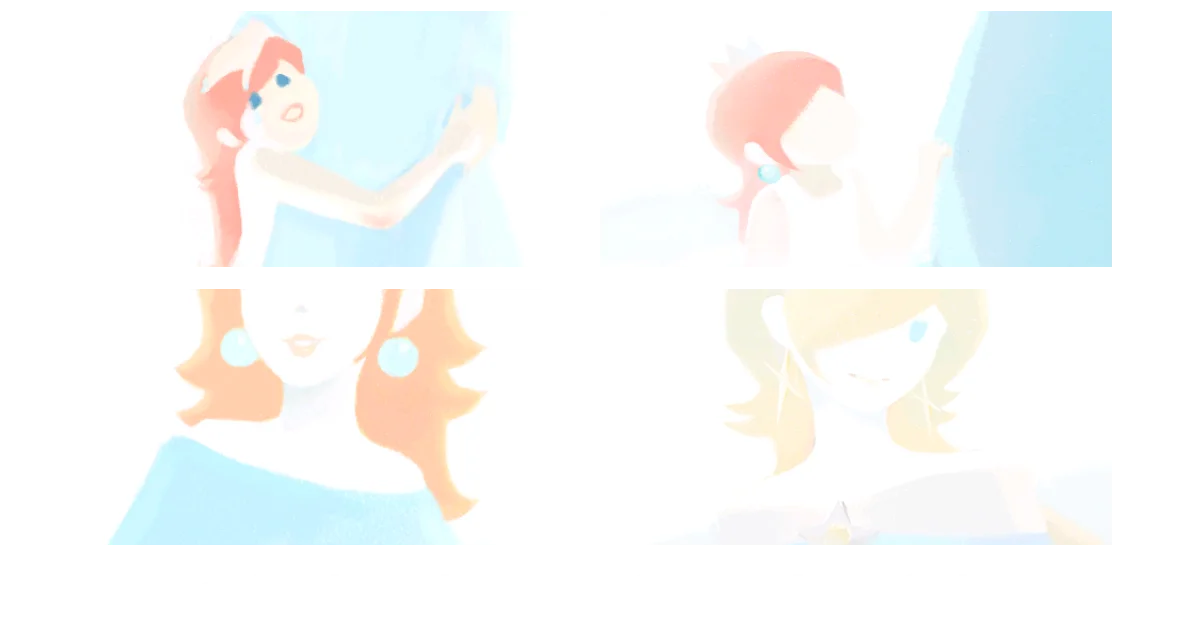
The terms “special one” and “special someone” are used frequently in the Super Mario Galaxy games. In Super Mario Galaxy, Rosalina refers to Princess Peach as Mario’s “special one.” In the ending of Super Mario Galaxy 2, Princess Peach refers to Rosalina as the baby Luma’s “special someone.” In Super Mario Galaxy 2’s storybook, Rosalina points out that the two stars “each found their special someone” in each other. Her younger self asks when she will meet her special someone. Rosalina’s special someone is never explicitly named, but it can be interpreted a few different ways.
It could be the baby Luma, and the Lumas in general by extension. This younger Rosalina has not met the Lumas that would become her adoptive children.
It could be her mother. “Special one” and “special someone” are used in the context of reuniting with someone you were separated from. Mario was separated from Princess Peach. The baby Luma was separated from Rosalina. Mari was separated from Lubba. Super Mario Galaxy 2 has an ongoing theme of not losing faith in the force that brings kindred sprits back together. This interpretation would tie nicely into that. It would also be a clear callback to chapter 3 of the same storybook, where Rosalina was reminded of searching for her mother.
It could be Mario, as meeting Mario brings Rosalina into a more active role in various spin-off games and mainline adventures. In hindsight, Mario significantly changes the trajectory of her life and allows her to open up more.
It could even be someone completely different, and this is simply alluding to a plot point from a yet-to-be-released game.
When Rosalina tells her younger self not to give up, she replies, “Yes, I think that’s how we must be.” The Japanese version also uses the equivalent of “we.” This suggests that Rosalina as an adult has yet to find her special someone, whoever that might be, meaning it couldn’t be the Lumas in this case. If Rosalina’s special someone is her mother, it means some part of her hasn’t fully given up hope of reuniting with her. How she would do so is unclear.
While the chapter where Rosalina talks with her younger self was released in 2026, the idea of this has existed since Super Mario Galaxy 2’s soundtrack release. The Japan-exclusive soundtrack cover includes a piece of art showing this interaction5, suggesting it was cut content from the original release.
Miyamoto stated that he “put a stop” to adding a deeper story than the one we got in Super Mario Galaxy 2’s original 2010 release.6 It isn’t far-fetched to believe that the storybook added to the game’s 2025 re-release were at least remnants of that deeper story.
Rosalina’s Home Planet
Rosalina says she aims to visit her planet once every one-hundred years. The Mushroom Kingdom’s Star Festival is also held once every one-hundred years, coinciding with the passing of a large comet passing by. This suggests that the comet is the Comet Observatory. If so, this also suggests that Rosalina’s home planet is the same planet as the Mushroom Kingdom, or at least a nearby planet is.
The pictures from Rosalina’s Storybook provide more evidence for this possibility. Behind the hill on Rosalina’s planet is a castle that resembles Princess Peach’s castle. Because Rosalina wears a crown on her home planet, it can be assumed that she is part of the royal family of said castle. And the limited glimpse of Rosalina’s mother resembles Princess Peach, suggesting that Rosalina’s mother either is Peach or is a relative of Peach. It would also explain why Rosalina’s regalia is so similar to that of Princess Peach.
One nearby planet would be the Gateway Galaxy planet that Mario first meets Rosalina on. Rosalina mentions that the planet is nostalgic to her1 and that she visits it once every one-hundred years as well. In the true ending cutscene of Super Mario Galaxy, the baby Luma emerges from a starship that resembles the one shown in the storybook. This allusion to the storybook could suggest that the planetoid was Rosalina’s home planet. However, this planet is very small and lacks any resemblance to the planet shown in the story. Furthermore, because the planet can be explored completely by the player, which confirms that there is no castle or hill with a grave on it. A planet’s features will change with time, but to remove these landmarks would be a confusing decision, both narratively and realistically.
With this in mind, it is likely that Rosalina was at one point living on Mario’s planet as a princess of the Mushroom Kingdom and the Gateway Galaxy planet may be the ice comet from the storybook.
Rosalina’s Age
A discrepancy that naturally arises is Rosalina’s age. Despite her appearance, Rosalina has supposedly been alive for at least a thousand years. There are multiple ways to rationalize this.
The naïve explanation would be that her powers have given her immortality. It would be fitting, given that stars are associated with invincibility in the Super Mario series.
Rosalina could be time traveling to her home planet to the next turn of the century, but that seems pointless and would abandon orphaned Lumas in the process.
If Rosalina ages naturally and eventually passes away, the Lumas could reset the universe to when she was a child. This would continue the cycle and allow the Lumas to once again set out on a quest to find their mother.
Occam’s razor suggests that it is simply Rosalina’s magic keeping her young. However, there is undeniably deeper meaning in the possibility that the Lumas reset the universe on a never-ending quest to be with their mother.
Rosalina as a Reliable Narrator
As silly as it may sound, the question does need to be asked: is Rosalina a reliable narrator? The storybook is written by (in-universe) and told by her, so the audience experiences the story exclusively through her lens. There are two things to consider with this.
The first is when the book was written in Rosalina’s life. It’s made clear that the story took place long ago, meaning it was written with a matured and honest perspective, rather than through the rose-tinted lenses of a child. Perhaps the story of a young girl finding and fixing a crashed spaceship and leaving her family to live in space without bringing water would be more difficult to believe if told by a younger Rosalina.
Second is the narrative purpose of the storybook. It was written by Koizumi to explain Rosalina’s relationship with the Lumas and why they were in space. To accomplish that, there isn’t a reason for Koizumi to outright lie or mislead the reader.
“But for those that would like a deeper narrative experience, I wanted to create a backdrop of Rosalina and the Lumas; what their relationship is to each other, how they came to the point they are at when you meet them, and how Mario had connected with a much larger story.”
Yoshiaki Koizumi4
Ultimately, yes. Rosalina is a reliable narrator and we can assume her storybook to be a more-or-less accurate retelling of her origin. It’s unlikely that Rosalina fabricated her backstory to the Lumas to become a cult-leader with magic powers.
Interestingly, one of the members of the Toad Brigade is suspicious of Rosalina, worried she might be a witch. Rosalina’s calm mannerisms and vague language can come off as nefarious under the right lens. Some players on their first play-through of the game might be suspicious of her.
Universe Resets
It is possible that the universe is reset like it is at the end of Super Mario Galaxy more often than we are led to believe. This would explain gameplay-driven dissonance across game entries, like Mario using power ups in some games while having a health bar in others.
The ending of Super Mario Galaxy suggests that Rosalina has witnessed multiple universe resets, but she is vague on the ramifications of one. The one the player witnesses effectively time travels back to the Star Festival at the beginning of the game, but with the universe and its inhabitants scrambled up.
One theory is that universe resets restart from the beginning of time with small modifications made. This has deeper meaning because it means that Rosalina being the mother of the Lumas is a constant. She chooses to become their adoptive mother every time, like a canon event. This fits nicely with the earlier theory that the Lumas reset the universe if Rosalina passes away.
It would also explain why Lumas claim her as their mother, as they recognize her from a previous cycle. The Lumas’ original mother is never explicitly shown. The only real information about her is that Star Bits remind the baby Luma of its mother and that the baby Luma was waiting for her to arrive on a comet. While the Star Bits comment could be argued both ways, Rosalina pilots the Comet Observatory, which is propelled by a comet that the baby Luma transformed into. Once again, the cycles theme of Super Mario Galaxy is relevant.
Design
Rosalina’s name varies across many languages. While most locales refer to her as Rosalina, in Spain, her name is Estela; in Italy, her name is Rosalinda; and in France, her name is Harmonie. Most notably, her Japanese name is ロゼッタ, or Rosetta. The name is believed to be named after the Rosetta orbit or possibly the Rosetta space mission. If true, this adds a layer of depth to her character, as it cements her association with space within her name. It is not unlike how Princess Daisy is so often associated with flower imagery or how Luigi is a pun on the Japanese word 類似 (pronounced ruiji), meaning similar (in relation to Mario). Having Rosalina’s Japanese name closely tied to the cosmos suggests that she was always destined to be among the stars.
On the topic of predestination, there has been speculation that the hairstyles of Peach, Daisy, and Rosalina hold symbolic meaning. Peach’s hair is shaped like a heart, Daisy’s is shaped like flower petals, and Rosalina’s bang represents a crescent moon. Whether this is intentional or not has yet to be confirmed.
According to members of the Super Mario Galaxy development team, the bang covering Rosalina’s right eye represents “outward strength and inner sorrow and loneliness.” This suggests that her design was finalized after Koizumi wrote her storybook. She was also intended to be related to Princess Peach early in development, which is why she looks so similar to her.7
The element of loneliness is expanded upon beyond her hairstyle. Rosalina’s voice naturally echoes in her early appearances. While this gives her an ethereal vibe, it also can be used to represent solitude.
Her original concept art shows a very different design for her character. Notably, she has a beehive hairstyle and her dress is much more in line with that of Peach and Daisy’s and she wears gloves. However, her crown is replaced with a tiara to accommodate her hairstyle.
In relation to Princess Peach and Princess Daisy, Rosalina seems to complete a triad of power-up-themed princesses. Princess Peach is the ruler of the Mushroom Kingdom, Princess Daisy has a strong association with flowers, and Rosalina has a strong association with stars. In addition to her backstory, she wears a star-shaped brooch, star earrings, a crown with stars etched into it, and her emblem is a Grand Star. The original three power-ups from 1985’s Super Mario Bros. are the Super Mushroom, Fire Flower, and Super Star. Whether this was intended or a lucky coincidence is unknown.
Rosalina towers over the main cast of characters, with many estimates putting her height over 7 feet tall8. The reason for this is because of Mario Kart Wii, which was in development alongside Super Mario Galaxy. Rosalina was originally about the same height as Princess Peach, however Hideki Konno, producer of Mario Kart Wii, wanted Rosalina to be the first heavyweight female character in the series.9 As a result, Rosalina’s height significantly increased to accommodate this request. Despite this fact, she is one of the lighter fighters in the Super Smash Bros. series.
Personality
In Super Mario Galaxy, Rosalina is a mysterious and stoic character. She doesn’t emote much, which allows her past to remain ambiguous to players who haven’t read her storybook yet. Even in Super Mario Galaxy 2 and its 2025 additions, she remains calm and prim. Much ado has been made about Rosalina’s portrayals outside of the Super Mario Galaxy series. In particular, the deviation from her serene persona and shift to a Peach-like personality.
In her first depiction outside of the Super Mario Galaxy series, Mario Kart Wii, Rosalina maintains most of her mannerisms from Super Mario Galaxy. She even keeps the echo in her voice, distinguishing her from the rest of the cast. While she opens up more in Mario Kart Wii, Rosalina feels more like a Super Mario Galaxy character rather than part of the main cast of recurring Super Mario characters. All-star roster games require a degree of uniformity across the roster, and she makes the bubbly exclamations the rest of the cast is subject to, but she is still sounds and acts distinctly alien.
Mercedes Rose is the original voice actress for Rosalina, portraying her in both Super Mario Galaxy games and several spin-off games. Rose has gone on record stating that she was asked to use a “motherly” voice for clips used in the original game and use a more energetic voice for clips that would go on to be used in Mario Kart Wii.10
Her fourth appearance, 2011’s Mario Kart 7 marks her first change of voice actress, now being portrayed by Kerri Kane.
2013’s Super Mario 3D World was Rosalina’s first playable appearance in a platformer. Her voice actress was changed once again to Laura Faye Smith after Kane moved away from Seattle, Washington. With some exceptions, much of Rosalina’s voice direction was inching closer to that of Princess Peach’s. Furthermore, at this point, the echo in her voice was removed, most likely to unify her voice direction with the rest of the cast. By 2014’s Mario Kart 8, Rosalina’s portrayal is night and day when compared to her voice clips in Mario Kart Wii.
It has been theorized that the removal of the echo and her new personality is a sign of Rosalina opening up more. However, this is more than likely a retroactive justification rather than intended character development. Nintendo makes a conscious effort to ensure that the roster of Super Mario characters has widespread appeal, and homogenizing the voice direction and personalities of the characters could be advantageous for marketing the cast. Despite Super Mario Galaxy’s admirable sales numbers, many people playing a Mario Party or Mario Kart game likely haven’t played the game, let alone read Rosalina’s Storybook.
The shift in personality has been a point of controversy in the fan community. Some fans find the shift to degrade the character by taking away what make her unique and effectively turning Rosalina into “blue Peach.” Other fans see it as a form of character development, saying that Rosalina shouldn’t act so glum all the time and joining the main cast warrants a personality change.
Musical Associations
Rosalina is most often associated with the Comet Observatory theme. The theme is a waltz the the key of D major that progressively adds more instruments as Mario collects more Power Stars. The first version is quiet and features a xylophone. It sounds like a lullaby and reflects the humble state of the Comet Observatory when Mario first arrives on it. The second version is mostly strings. It fits Rosalina’s proper and formal demeanor very well. The final version adds brass to the strings, complementing the lively and bustling Comet Observatory, while keeping the same melody at its core.
Rosalina is also shown several times throughout the series playing the guitar. In Super Mario 3D World’s soundtrack album art, Rosalina is shown in her cat form playing the electric guitar. In concept art for Super Mario Odyssey, a game in which she does not appear in person, Rosalina is shown in casual attire playing an acoustic guitar. Finally, in the 2025 epilogue of Rosalina’s Storybook, Rosalina plays the Lumas a lullaby on her acoustic guitar.
Despite her having the guitar in the epilogue of the storybook, it isn’t listed as one of the items that she brought into space, suggesting that she may have found or built it at some point.
Powers and Abilities
Rosalina exhibits a number of powers and abilities throughout her appearances. For example, upon meeting Mario, she is surrounded by a bright glow and leaves by levitating and fading away. Magical powers are no stranger to the Super Mario series. Most notably, Magikoopas are a species of wand-wielding Koopa wizards often associated with teleportation and transformation.
Rosalina often floats in place and while moving. This is most noticeable in Mario sports games, like the Mario Tennis series. Some speculate that the developers had her move in this way to avoid needing to animate her walking and running. That may have played a role, but ultimately, Nintendo would likely reuse the animations used for Peach and Daisy. Because she doesn’t use her wand in this context, it can be inferred that this ability is separate from her wand.
This is also the case in the Super Smash Bros. series, where Rosalina’s running animation is more akin to gliding. Similar running animations were given to other ethereal or magical characters, including Palutena, Pyra, Mythra, and Sora. Despite this fact, they are still prone to slipping on banana peels.
Beyond floating, Rosalina has shown the ability to fly freely in many of her appearances. Notably, Super Mario Bros. Wonder – Nintendo Switch 2 Edition + Meetup in Bellabel Park showcases Rosalina flying freely in cutscenes, but she is anchored by gravity in gameplay.
Rosalina has also been shown to be able to speak telepathically and project herself.
Rosalina can manipulate other objects using her wand. If Mario falls off of the Comet Observatory, he is magically pulled back onto the ship. In Mario Golf: Super Rush, Rosalina swings her golf club using her wand. Her wand also allows her to pilot the Comet Observatory.
Defensively, Rosalina is able to create a bubble-like shield around herself. She is also able to deflect Star Bits with her wand.
Ultimately, it’s clear that Nintendo does not have a Star Wars-style rulebook on how these powers work. Rosalina’s repertoire of powers grows and shrinks as needed. She can float and fly, but can still fall down pits and slide on ice11. Her power-scaling is relative to her role in each game. As a playable character in games like Super Mario 3D World, she needs to be close to other characters to keep the gameplay balanced. In non-playable roles like Super Mario Galaxy and Mario + Rabbids Sparks of Hope, she is depicted as much more powerful and has access to more abilities.
Association with Ice
Over the years, Rosalina has had some associations with ice. In Mario Kart 7, the first course with Rosalina’s namesake was introduced: Rosalina’s Ice World. The course is a snow track featuring the Comet Observatory and a water section that resembles Cosmic Cove Galaxy.
The course was conceptualized by Retro Studios12, so the authorship of the ice concept is fairly well removed from Koizumi. That said, Nintendo EAD, who developed Super Mario Galaxy, was one of the developers of Mario Kart 7. So while Koizumi did not work on Mario Kart 7, there may have been some overlap between the teams of the two games.
Originally, I had thought that Rosalina’s similar aesthetic to Elsa of the Frozen movies led to the creation of Rosalina’s Ice World. This would be a way for Nintendo to capitalize on the character’s popularity. However, Mario Kart 7 came out in December of 2011, while Frozen released in November of 2013, making this timeline impossible.
The mobile game Mario Kart Tour gave Rosalina an Aurora Borealis-themed dress for the game’s Vancouver Tour in 2020. This costume has the Ice Flower as its special power-up.
In 2022’s Mario Strikers: Battle League, her Hyper Strike move is called “Orbital Burst.” Rosalina launches the soccer ball into space, where it orbits around a planet and falls back to Earth, encased in ice. As Rosalina kicks it towards the goal, it leaves behind a trail of ice.
Mario Kart World continues this theming with the addition of the Starview Peak course. Like Rosalina’s Ice World, this course includes the Comet Observatory in a snowy region.
In addition, the Mario Kart World Direct trailer reveals the Ice Flower item with Rosalina in her Aurora outfit.13 Rosalina also is depicted using the Stellar Sled, a snow-themed motorized sleigh, in promotional trailers and when racing as a CPU.14
All of this is despite the fact that Rosalina has never been shown using an Ice Flower outside of Mario Kart.
Nintendo likes to have distinct colors for each character and their respective power ups forms for visual clarity. Rosalina is already a frost-blue color, so a new design would be needed for her ice form. If she were to power up with an Ice Flower, her Aurora form would likely be the result, as it provides a distinct color. Nintendo might take steps to avoid this, as it would break the consistency with the existing Ice Flower color scheme, and could cause confusion to new players.
Given Rosalina’s heavy affiliation with space and the stars, the references to ice clash a bit. The reason for this likely boils down to marketing. Rosalina wears a light blue dress, which matches with frosty and cold themes. Space also is often associated with the cold. It’s simple to understand for a player who has never played Super Mario Galaxy and doesn’t know who Rosalina is.
Furthermore, new issues arise if Rosalina was given a space-themed track in Mario Kart. This course would probably be too similar visually to the Rainbow Road tracks, which take place in space as the penultimate course of each Mario Kart game. It’s a course that needs to feel distinct and impactful. Having multiple snow or desert courses in a Mario Kart game is fine, but space-themed courses should be reserved for Rainbow Road. By this logic, it makes sense to have Rosalina defer to an ice theme. Combine this with the blue dress and the coldness of space, and it becomes a no-brainer.
Handedness
On the topic of her wand, Rosalina has been depicted wielding it with both her left and right hand. Excluding sports games where the player can choose handedness, there is very little rhyme or reason as to which hand she uses, suggesting that she is ambidextrous. Often she is depicted in artwork as right-handed, but left-handed in game, but occasionally the opposite is true.
Even her use of a guitar is inconsistent. Super Mario 3D World’s soundtrack album art shows her as right-handed, but her Super Mario Odyssey concept art shows her as left-handed. The 2025 epilogue of the storybook switches back to right-handed.
Rosalina as a Princess
Rosalina’s status as a princess has been a point of contention in the community. While she has a crown and a dress, she isn’t referred to as a princess in the games. This may seem trivial at first glance, but honorifics are a critical part of Japanese language, so the absence of a princess title leaves room for interpretation. While honorifics typically aren’t used as often in works of fiction in Japanese, Peach is often referred to with the 姫 (pronounced hime) honorific for princesses.
Some paratext, including English marketing, has referred to her as “Princess Rosalina,” but these sources are fairly well-removed from the original authorship.
The biggest argument against Rosalina being a princess is Nintendo’s intentional usage of the title with Peach and Daisy, but not with Rosalina.
In Super Smash Bros. Ultimate, there is an Event Tourney called A Most Regal Battle. This special mode only allows the player to select characters who hold royal titles. Notably, Peach and Daisy are selectable, but not Rosalina & Luma. Even Bowser Jr. is an option, who would be considered a prince. That said, it could be argued that Luma’s presence would disqualify the duo from representing a “royal fighter.”
Additionally, there is a Classic Mode route that makes reference to royalty. King Dedede’s route is called “Royal Rumble” and pits the penguin king against characters with royal titles, none of which include Rosalina.
The Super Smash Bros. series, while published by Nintendo, is wholly separate from Koizumi’s authorship, so this cannot be taken as definitive evidence. It’s also important to note that canonically, the entire Super Smash Bros. series is taking place within the imagination of someone playing with toys of their favorite video game characters, so deviation from source material is expected.
Confusingly, one page on Play Nintendo uses the phrase “Calling all royals,” then proceeds to refer to the trio as “Princess Peach, Princess Daisy, and Rosalina.”
Nintendo has a habit of referring to the trio as “Princess Peach, Princess Daisy, and Rosalina.” When focusing exclusively on Rosalina, she is often given a more ethereal title, like “Guardian of the Stars”.15
It can be inferred that Rosalina was a princess of the Mushroom Kingdom, but putting aside the title of “Princess” was one of the costs of leaving her home for space. She still wears the crown to pay homage to her roots, but now takes on the role of mother and “lady of shooting stars” instead of princess. The Comet Observatory (and outer space for that matter) is not a kingdom to be ruled over. With this interpretation, it isn’t wrong to call her a princess, but her other roles supersede that title.
Rosalina as a Witch
Although Rosalina wields a wand and possesses magical abilities, Rosalina’s affiliation with being a witch is something that is less obvious, especially to the English-speaking audience.
The first hint comes from Super Mario Galaxy, where the Blue Toad of the Toad Brigade anxiously speculates that Rosalina is a witch.
In the English version of Super Mario Galaxy 2, Rosalina is referred to as the “lady of shooting stars” by Lubba. However, in the Japanese version, she is instead referred to as ほうき星の魔女, or “Comet Witch.” Furthermore, the Cosmic Spirit that resembles Rosalina is known as おたすけウィッチ or “Helper Witch” in Japanese.
Curiously, the two characters use different words for witch. Rosalina is referred to with the term 魔女, or majo, which can refer to both Western-style witches as well as female figures with magical abilities in Japanese folklore. The Cosmic Spirit is referred to with the term ウィッチ, literally the English word witch, which exclusively refers to Western-style witches.
Rosalina has had two outfits specifically making reference to this Western-style witch allusion, both relating to Halloween.
Mario Kart Tour added a special witch-themed costume for Rosalina as part of the game’s Halloween Tour in 2019. She wears a purple dress and witch’s hat.
In 2021, Nintendo released Halloween-themed artwork for several Super Mario characters, including Rosalina. This artwork depicts her on a witch’s broom. She also wears her blue dress, a cape, and a jester’s hat.
It’s most likely that Rosalina would fall closer to the Western-style witch category. Japanese media is no stranger to depicting Western-style witches. One of the most famous examples would be Hayao Miyazaki’s Kiki’s Delivery Service, a coming-of-age story that features a young witch who rides a broomstick.
Rosalina would not be the only witch, or magic-wielder for that matter, in the Super Mario universe. Many of these depictions fit a Western depiction of a witch or warlock, but also fall into the extended Super Mario universe, like the RPGs and Wario series, far removed from Koizumi’s authorship. The nearest magical neighbors in the Super Mario Galaxy games would be Kamek and the Magikoopas, who use magic with a wand. In the opening cutscene of Super Mario Galaxy, Bowser is briefly shown the ability to wield lightning without the aid of a wand.
Rosalina’s Relation to Princess Peach
Arguably the biggest mystery that has puzzled fans is Rosalina’s relation to Princess Peach, at least as far as the games are concerned. Although The Super Mario Galaxy Movie establishes that Princess Peach and Rosalina are sisters, this is a separate continuity, as evident by the movie’s retcon of Rosalina’s mother and brother. The development team of Super Mario Galaxy (the video game) made clear that Princess Peach and Rosalina were originally intended to be related in some way.7
In the early stages, we contemplated the idea that Rosalina was related to Princess Peach, so that is why their features are very similar.
In addition, Shigehisa Nakaue, the artist behind Super Mario’s iconic 2D art, recently made a statement regarding their relationship in the games.
There are some scenes in the [Super Mario Galaxy] game that sort of… they sort of allude to [Peach and Rosalina] being blood relatives.
Shigehisa Nakaue16
Obviously, being related goes beyond sisterhood. There are two main theories worth discussing that could be intended interpretations of the texts.
The first is that Rosalina is a distant ancestor of Princess Peach. She once was a princess of the Mushroom Kingdom, but went off into space, as her brother continued the Mushroom Kingdom’s bloodline, eventually leading to Princess Peach. Rosalina lives through thousands of years to eventually bring her to current day.17
The second is the Rosalina is Princess Peach’s daughter from the future, who has somehow returned from the future to see her mother.
I originally dismissed this theory because time travel is seldom used in the Super Mario series, and is not explicitly mentioned at all in Super Mario Galaxy. In addition, Rosalina finally meeting her mother would partially defeat the meaning of Rosalina’s Storybook. Rosalina had to let go of her mother and welcome in the Lumas to heal her heart, so having Rosalina meet her mother, while a nice way to bring things full circle, didn’t seem right. However, with the 2026 epilogue to Lubba’s Storybook, a crucial piece falls into place that could make this make sense.
As mentioned earlier, the young Rosalina says that both her and current day Rosalina must have hearts that never give up when it comes to finding their “special someone.” If Rosalina’s special someone is indeed her mother, it would make sense that she never gave up trying to find her. That enduring hope is what the young Rosalina ultimately represents in the epilogue.
There is evidence of Rosalina being Peach’s daughter. The dream sequence from Rosalina’s Storybook shows the bottom half of her mother’s face. Her mother bears a striking resemblance to Princess Peach, even down to her blue earrings. Rosalina’s father is said to have a mustache, which suggests that her father is Mario. The fact that Rosalina refers to Princess Peach as Mario’s “special one” would reinforce this. If true, it would stand to reason that Rosalina would not tell Mario, and by extension the player, that she is their daughter, as that would presumably lead to a rift in the space-time continuum.
In Super Smash Bros. for Wii U, her clear image for her All-Star Mode is an image of her surrounded by Princess Peach and Mario. Some have suggested this is a hint towards Rosalina being their daughter, but the authorship is far removed from Koizumi.
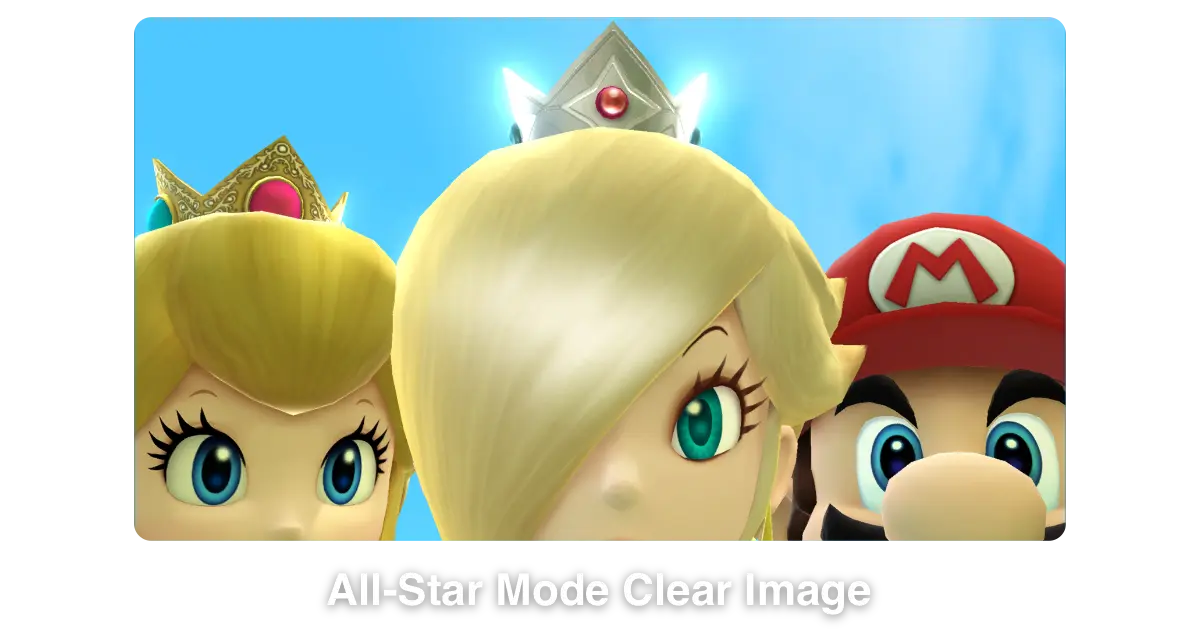
There are a few issues with this theory.
First, Rosalina plays a critical role in Mario saving Princess Peach. Some interpretations of time travel don’t allow for this to be possible, but they could be bypassed if time travel goes by predestination rules.
Second, Rosalina doesn’t know Mario’s name until the Toad Brigade tells her. However, this could be explained by her acting coy and pretending to not know his name, which would make sense given she never asked for his name earlier. As unlikely as this explanation is, it is established that Rosalina had been observing Mario and Peach from afar before meeting him.
While it’s most likely that Rosalina being related to Princess Peach was just a concept that didn’t make it to fruition, Koizumi may have intended Rosalina to be Princess Peach’s daughter but had to leave it to fans to put the pieces together. Since it implies that Princess Peach will die sometime after Rosalina is born, Nintendo would never allow Koizumi to make more than a vague hint at this possibility.
Conclusion
The truth of the matter is no amount of media analysis or even new information from Nintendo will ultimately yield a satisfying answer for everyone. If social media is any indication, fans all have their own interpretation and theories on the gaps in Rosalina’s backstory. The only backstory or fan theory that matters is the one that you find the most interesting. Film critic Roger Ebert’s commentary on 2001 always seems to come to mind when discussing loose threads in stories.
“I felt that the poetry of ‘2001’ was precisely in its mystery, and that to explain everything was to ruin everything — like the little boy who cut open his drum to see what made it bang.”
Roger Ebert
While Rosalina’s story leaves a lot of gaps for the audience to fill in, they were never meant to have a true cohesive answer. The reality is that Super Mario Galaxy isn’t that deep.
It’s a game that wanted to bring the concept of planetoid-based platforming to fruition. Spinning and collecting Star Bits were added to give the Wii Remote, Nintendo’s brand new motion-based controller, a gameplay purpose. The baby Luma exists to bestow the former’s ability onto Mario and provide a narrative purpose as to why Mario has this new ability. Rosalina was added to give the player a hub world and to add another playable character to Mario’s growing repertoire of spin-off games. Gameplay and marketing ultimately take precedence over story when it comes to making a Mario game.
With Rosalina’s origin being overhauled in The Super Mario Galaxy Movie and suggestion from Miyamoto that future Mario games will adopt this new canon18, it is possible that Rosalina’s original backstory is at a dead end.
However, there is hope for fans of the original Rosalina. The addition of new storybook segments in 2025 and 2026 breathed new life into the backstory that was left untouched for nearly two decades. The renewed interest in Super Mario Galaxy has fans speculating in a potential Super Mario Galaxy 3.
Regardless of what the future holds, it is clear that whatever is next will hold a new era for the lady of shooting stars.
Citations and Notes
-
This detail is from the Japanese version of the text. ↩ ↩2 ↩3 ↩4
-
https://iwataasks.nintendo.com/interviews/wii/super_mario_galaxy/0/0/ ↩
-
February 2008. Nintendo Power V225. Future US (American English). Page 66. ↩ ↩2
-
Black, F. (2007). Super Mario Galaxy Prima official game guide: Collector’s edition (p. 346). Prima Games. ↩ ↩2
-
https://www.reddit.com/r/NintendoMemes/comments/11ukc3g/comment/jcoinq0/ ↩
-
July 2008. Nintendo Dream. Page 74. ↩
-
With the exception of Mario Tennis Fever, in which case, she is immune to slipping on ice. ↩
-
https://iwataasks.nintendo.com/interviews/3ds/mario-kart-7/0/3/ ↩
